Showing posts with label Raleigh Grand Prix. Show all posts

Saturday, October 2, 2010

Lets Build A New Road Frame

I'm going to design and build a new road frame and fork. I've been riding this Raleigh for some time now. It's a little tall for me, but this is old school geometry.
Over the next week I'm going to decide on what changes to make. I'm supposed to ride a 54cm or 55cm frame Measured from the center of the bottom Bracket, to the center of the seat cluster. This frame measure 58.5. So it's almost 2" too tall.
It also has a 57cm Top tube. At first most people will say that too long for me. But you have to do the math. Top tube length and reach are not the same. This frame has a . . .

. . . 72 degree seat tube angle. (This digital angle finder is accurate to 1/10 of a degree) A typical 55cm frame might have a 73.5 degree seat tube angle and a 55.5cm top tube. These number come out to be about equal. The slacker 72 degree angle brings the head tube back towards the bottom bracket about 1.5cm. So the reach on this bike work well for me, I just can't get the bars down to where I like them to race. For commuting this height is actually pretty nice. The top of the bars are about 2" below the saddle, about where I like them on my MTB. However I'm going to build this frame to race, so I'm going to build a frame where I'm going to ride in the drops of the handle bars, as opposed to a touring/commuting bike where you ride on the top of the bars.


By the marking on the lugm we might assume it's a 72 degree head tube, but we all know it could be off. The head tube is too short to use my digital angle finder, even removing the fork doesn't really help because I've still got the head tube badge to navigate. What I did was bolt on a couple tubing blocks from my jig to the head tube, then measure it with a combination of different levels and campass, and my digital angle finder. I found using 3 different methods the angle is between 72.0 and 72.1 . . . not bad work. The seat lug is also labled 72 and I suspected it was 72/72 since it's a 70's frame from England.


Now the fork . . . got rake?


62mm of it. I've still got to do the math to find the trail. Most frames today have a head tube angle around 72.5-73.5 degrees. Almost all forks have a rake of 43mm to 45mm.
I guess I'm old school, or maybe it's just what I'm used to. but I like lots a rake. I've ridden a few frames with a 73.5 head angle, and 43mm of rake, and while I would describe it a twitchy. I will say it's like steeering a marble. or like one of those Dyson ball vaccum cleaners, it'll turn quick, but I'm not sure to what end. I mean your going to spend a great proportion of the race fighting the bicycle to keep it straight, so you might take advantage of quicker handling for a moment.
Don't get me wrong. I know the over years bicycle manufactures have gravitated to the geomtries they have through trial and error, and these geometrys work good for the masses. If your not buying custom, your buying one size fits all so to speak. I will say it's a lot more open now than it used to be where almost every manufacture used about the same geometry give or take a 1/2 degree or centimeter here or there.
I'll have to work this trail thing out tomorrow, should be interesting. 62mm of rake Not to mention the 395mm axle to crown, most forks these days are 370mm-372mm. It's a commuter's dream, just not a racer's.

Sunday, August 30, 2009

Week 6

What? . . . expecting a spreadsheet? . . . well you get that later. Well here's the Raleigh Grand Prix commuter to Cyclocross Racer transformation progress. Looks like a Vintage Retro Project . . . . or is it just vintage, because this frame and fork is the real deal 1970's.
-
It's a mid-level frame and fork from the 70's. Let's contrast this to what you get today. Look at the detail.

-
I can't put canti mounts on the fork. I need them to be 80mm apart and I'd be lucky to get 70mm, oh well. I have plenty of mud clearance. Mostly because the frame was built to have 27" wheel and not 700c. 700c are slightly smaller.
-
However these Dia-Compe cneter pulls might turn into mud collectors in the right conditions. Check out the lugs, and the fork crown. Everything at this level is TIG welded.


-
Levers of Plenty. Yes those are down tube levers combined with STI. I'm going to switch to STI. I got the Suntour cable stops to do it. I just don't have the deraileur cables yet. Note the braze on clamp-on stop.

-
I'm not a big fan of wrap around seat stays, but I got what I got.


-
Note the cable stop for the Simplex front deraileur. For cyclocross season I'm going with one chainring so this isn't an issue. I don't think I ever used the big chainring on any of my past cyclocross bikes. Also you can see the over bottom bracket guide.

-
Perfect to for center pulls. Check out the rear brake cable stop. Today they just give you one of those aluminum things that attach behind your seat post bolt.

-
I like the rear brake cable guide and cable stop.

-
I might have to upgrade this if I can't find an aluminum post, Yea this is a chunk of weight.

-
-
Week 6 down. Looks like I was going fast, or I was going slow. I'm not sure where my training is going. I just make it up as I go . . . kinda . . . I want to but in base mile increasing distance, and I've been putting in a couple days of tempo. Not too hard, but a pace with a little hustle to it. I wanted to put in some more volume . . . didn't get that done. I wanted to go over 40 miles for one ride . . . didn't get that done. So what did I do? I put in intensity. For the week I increased my average speed one mile an hour.
-
Also Saturday I just wanted to go out for a joy ride. Just enjoy riding my bicycle. Sometimes you have to look around. Otherwise what's the point, I might as well be riding my indoor trainer. It was Great weather, and a great ride down Blue River Road. Probably should have done it a coule times . . . oh yea I couldn't I found a sledge hammer in the road. I really needed one. Sledge hammers are not cheap, Also just a note to all, people tend to give you funny looks when you have a sledge hammer in your jersey pocket.
-
I have a 17.3 mile route that I've been keeping my times on since 2004. The route has stops and traffic so you never know how it's going to go. I guess I use it as a guage to see where I'm at. I rode Friday with the goal of putting in the most Zone 4 time in one ride. Why? . . . Don't know. I felt with just a few week till the first week it was time to see where My fitness level was at.
-
(Click Spreadsheet to Enlarge)


Wednesday, October 8, 2008

Not what you think

It's not the SuperBee. It's been raining and I'm tired of getting wet. So I finished building up the Raleigh because it has fenders. This frame measures 23" center to center or 58.5cm. Yea it's to big for me by conventional standards. But the frame was the right price . . . free. Thanks Bruce!


The frame was designed for 27 inch wheels, not 700c. Normal brakes won't reach, so I found some long reach Dia Compes and they do the trick very well. The even have a little room left.


So what is the difference between 27" and 700c? . . . 27"= 630mm dia., and 700=622mm dia. so 8mm or it lowers the bike and adds 4mm to the brake reach. The Bottom bracket height is with 700x25c tires is 265mm so it's on par with a lot of frames designed for 700c. I have a Fuji the measures 263mm. I'm going to put a set of Jack Browns on it so it will raise it up a little more. Not that it needs to be raised up to compensate for the difference. I'm just pointing out the change can be done.


I found this old seat a long time ago. and what luck it's a Brooks. The quintessential old school saddle. It's a little tattered and worn. I'm told these are the most confortable seats ever made. They have been around for over 100 years. So I gave it a shot, and it looks good on the bike. Yep about as hard as it looks. They say you have to break them in. Basically they form to "your" butt after a while. So this begs the question . . . Who butt is this seat formed to since it's at least 30+ years old. I say that because I've had it for at least 15 years sitting in an old cabinet.


Oh yea that short stem. 6.5cm. Normally I would use a 12cm with a 55cm top tube (67cm roughly). This top tube measures 22-1/2" according to Raleigh, and that matchs my measurement of 57.2cm. So basiaclly I need a 10cm and I would agree,only this is all I had. Notice I don't have any tape in anticipation of the switch. But it's a nice old 3TTT though. Wish it was 10cm.

Over all I like the ride. As far as the frame being to big it's debatable. I'm using it as a commuter.
The seat tube is longer than I'd like, but I can still adjust the seat up and down, So I'm good to go. Also a consideration is whether or not I can get the bars low enough. When you have a frame and it has a horizontal toptube, the longer the seat tube, the longer the head tube, the longer the head tube, the higher the bars come up. and the answer is yes. I want them about 1 to 2 inchs below my seat on this rig, and I can go even lower.

The top tube is longer than I'd like, but I can adjust the reach by getting the right size stem, Ironically even with a long toptube I still need a longer stem.

Some people worry about Standover height. I can't figure out why people worry so much about it this. I have about 1/2" clearance, maybe more on a cold day when "The Boys" are retracted, but it's been hot lately so "The Boys" are relaxed and I got about 1/2". Anyway some people say they need 2". Look if your out riding, and you find yourself straddling the toptube, with both fleet flat footed . . . you not riding your bike . . . and if your not riding your bike, then what's this got to do with riding your bike? . . . Mountain bikes are another issue so I'm just sticking to city commuting . . . even when I stop I have one foot on one peddle, and I lean the bike. You have to lean the bike to get on and off anyway. To me standover height is the most usless dimension manufactures publish for frames that have horizontal toptubes. The only use I've really had for it is to determine other dimensions. say they don't give bottom bracket height, or drop, I can determine that by using the seat tube length, seat tube angle angle, and standover height assuming it's a horizontal top tube . . . yep that was a little rant.

Thursday, September 18, 2008

What's he into now?

I was able to find out what year my Raleigh was made.
It's a 1970. I can only image what a boat anchor this bike was. I suspect it's all steel except for the stem, tubes, and tires. It's vintage.
However not all vintage things are not bad things, you can find some good buys on E-Bay, Craigs list, or other place if you know what to look for.

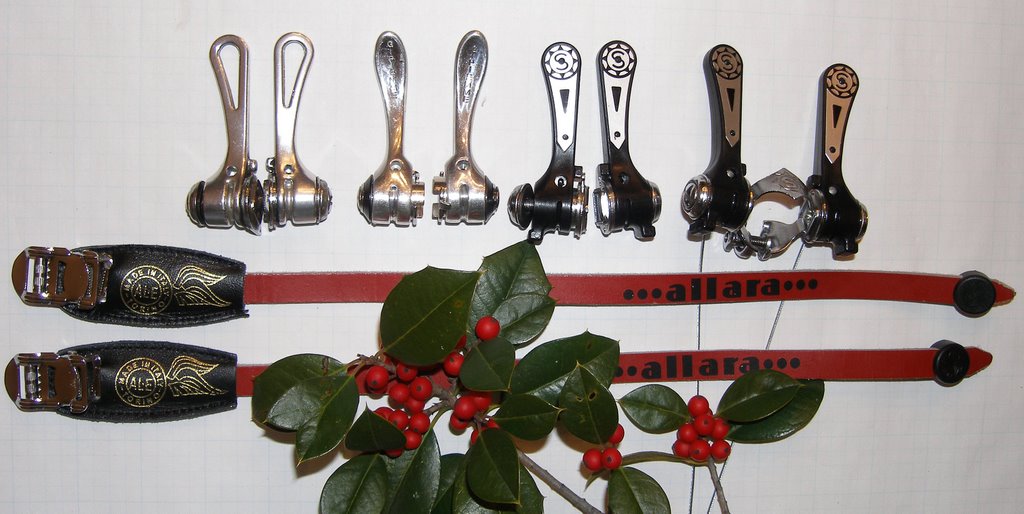
For example Suntour "Power Ratchet" shifters

So what gives these levers the POWER. It's the racheting wheel. Ahhh yes the days of Friction shifting, back in the day when people actually had to shift their bikes. The levers are designed so that when you pull back there isn't friction, all you feel is the tension of the derailleur spring. but the ratcheting wheel doesn't let the shifter shift down. Now in this respect it performs like a friction shifter.

I took mine apart to clean it and make sure nothing inside was broken.
An now re-assembled with smooth Phil Wood Grease for buttery smooth action. "Very Simple, Very Easy" (Does anybody in Kansas City remember "The Green Grocer".
Suntour's bar end shifter work on the same principle and were the king of bar end shifter for a long, long time. Suntour was not the only manufactures to make retro-friction levers.
Simplex for one. If you were a fan of the Pro peleton in the late 80's a lot of pros dumped their Campy or Shimano lever for the ones you see on the very left). They are very nice . . . Who knew I'd ever praise a french manufactured component? . . . Oh and my love for Mafac brake calipers, but I'll save that for another day.

(Photo borrowed from Orange velo)
Notice the more compact and elegant designs.
I think Simplex went out of business and In the early 90's Mavic took over the design and sold it along with the Mavic component group. Campy would also make a retro-friction lever in the early 90's. Funny enough Shimano never did jump on that band wagon as far as I know. They went straight from friction to index in one swoop.
In my research to fins information on Simplex deraileurs and shifter I found this cool site on Old school derailleurs. Or are they so old I think you have to call them "Old World" shift levers.
Then visit his whole Site Tony Hadland's Links

Tuesday, September 16, 2008

My Raleigh Grand Prix

So what's this all about. I build frames so why build up and ride a bicycle I didn't build? Well it's all about compare and contrast. I want to build a randonneur/touring/commuter bicycle, so I have to have something to compare it to. If you read earlier in my blogs, you know I built my current road bike to match my Time Trial bike position. It sacrifices comfort for a more aerodynamic position.

So there you have it. A Blue 23-1/2"( 59.5 C-T, or 58 C-C) Raleigh Grand Prix.


It a heavy Steel, Lugged Frame, it's not top of the line, yet this frame has some nice features. I like the head-tube badge.


The frame and fork was built in the Carlton Factory.


The bike came with center pull brakes. I like Center pulls so it's not a problem for me, exspecially when it came with 27" wheels, I'm going to use 700c. I'm going to able to do that because I acquired a set of Dia-Compe long reach calipers, This is also going to give me a little more room for fatter tires and fenders


I love the flat crown. This gives longer fork blades and more flex for road shock.


I like the chrome fork blade to elimated chipped paint from road debris.


Ahhhhh The bottom bracket. If you know anything about this frame, you know about the proprietary threading. Raleigh used 26tpi (1 3/8" X 26 tpi), not 24tpi. I had to ream out the thread, then re-thread the bottom bracket to Italian (70 mm width, 36 mm x 24 TPI).

I also had to face the ends of the bottom bracket from 71mm to 70mm, luck for me Italian isn't 68mm like English standard thread.

A purest my cring at the thought of not keeping it original, but this bottom bracket is a lot better than the original, also it's easy to replace. The original BB is for a cottered crank. I could probably search around to find something to work, but why when I can get something together faster, better, or all together more functional?


Nice! . . . Braze on center pull cable stop


Wrap around seat stays. If you look close you will see a 72 stamped on the lug. I suspect the seat-tube angle is 72, but builders can manipulate lugs to different angles.


Now the dropouts. They are horizontal, or are the semi-horizontal? They are angled so if you move the wheel back you will not exceed the reach of the brake caliper.

(It's funny how today if you get a single speed frame the dropout are true horizontal, like those on a track frame, but remember a track frame does not use brakes . . . so are those frame putting form over function? )


And last but not east an old vintage panel paint scheme.

Tommorow I'm going to measure the frame and make sure it's alligned.