Showing posts with label There I fixed it. Show all posts

Saturday, June 1, 2013

PD-M959 Pedal Rebuild and Frozen Knee Saver Removal

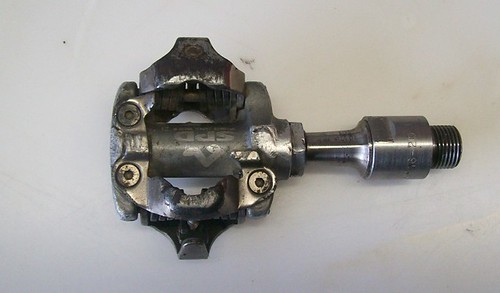
I have a set of Shimano PD-M959 (Before XTR) pedals that I put a set of KneeSavers on that got frozen on the spindle. I put the kneesavers on to give myself ankle clearance for when I wore my winter shoes or shoe covers. I discovered this winter I really don't need to be spaced out that much, so I decided to remove them. What I discovered was they were frozen to the pedal spindle.
m959_01
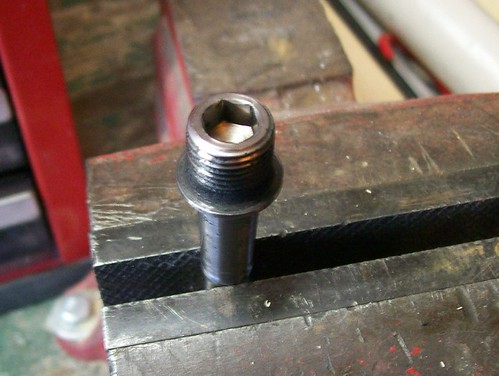
The problem is this model of pedal does not have the usual 15mm flats on the spindle to tighten the pedal to the crank arm. Instead the pedal can only be tightened using a 10mm allen wrench on the back side of the spindle. However the backside of the KneeSaver / extensions is solid and covers the allen wrench access. So the question is, how do I get it tight? A strap Wrench and as you can see the KneeSavers have 22mm flats.

m959_02
The first thing I did was drill a small 3/32" hole through the backside of the extension to allow a penetrant like PB Blaster, WD-40, or Liquid Wrench access to the blind side of the threads. After a week of soaking it didn't budge. Time for the frozen bolt torch technique.

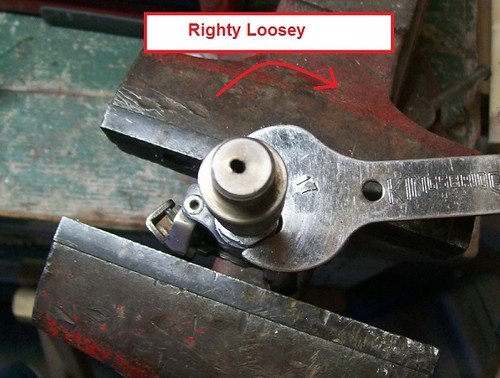
I had to remove the spindle from the pedal body and disassemble it. First you need a 17mm wrench and since this is the right/drive pedal the threads are left hand thread. Why left hand thread? If they were right hand thread and through a process of "mechanical precession" they would loosen up over time. So it's Righty Loosey.

m959_04
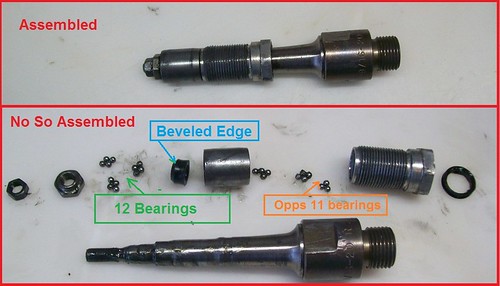
Unassembled and ready for the torch. Those are 3/32" bearings, even with a magnetic bowl one managed to escape me. No big deal since 12 fill the whole bearing race.

m959_05
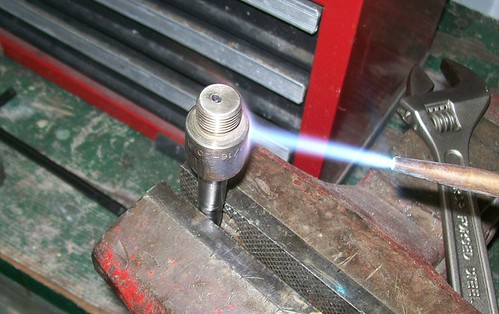
The idea with the torch is, you want to heat the extension so it expands breaking the bond between the two. You want to heat the extension, not the spindle as best you can, so keep the heat on the extension. Yu want to heat the extension so you get a little discoloration. Too hot or you will be deforming the threads and possibly welding the threads together...you don't want that. Once you start getting some discoloration you might hear a popping sound of the two becoming unbounded.

m959_06
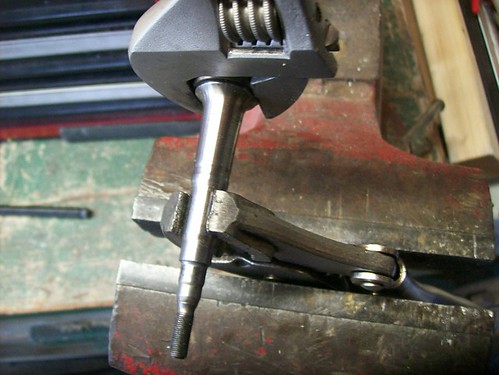
Let it cool, but while it's still a little hot, see if you can work it loose. I was able to get about 1/16 of a turn, and that was just enough to get some momentum. Be careful here, the vice grips are clamped on the flat part, not the bearing races.

m959_07
1/16th of a turn became 1/8th, became 1/4 turn and so on. After about 15minutes of work the kneesavers/extensions are off.

m959_08
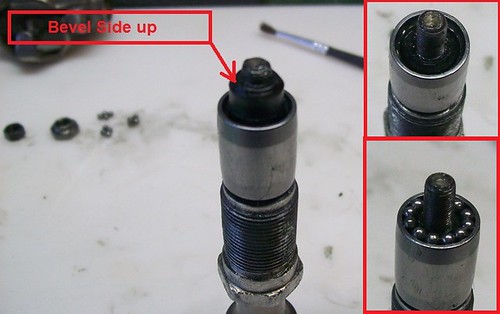
You have to put those 12 bearings on the bearing race in that barrel looking thing, then slide the barrel thing over the spindle. Use a fair amount of grease, this will allow the bearings to stick and not fall out. Remember to put the plastic bearing retainer back in with the beveled side up. Then just put in the last set of 12 bearings.

m959_09
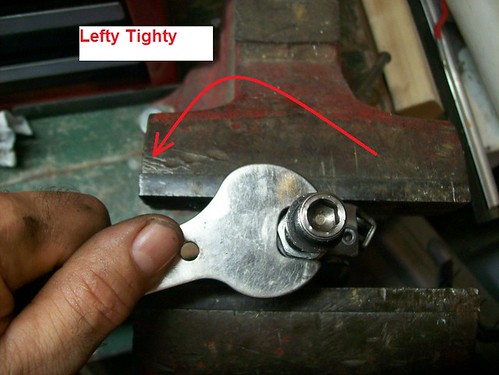
Remember it's Left hand thread. So it's Lefty Tighty! There you have it. I used PhilWood grease so it's buttery smooth.

Monday, November 19, 2012

The Ultegra FH-6500 Rear Hub Rebuild

Call me a non-contemporary, or whatever. As far as having a set of road racing wheels, I'll consider having a set of wheels that follows the whole wheels concept. However for training, or Cyclocross I like the conventional 3cross (or 2 cross), 32 spoke wheels. No special spokes, just conventional J-bend spokes. I got a set of wheels with Ultegra FW-6500 series hubs last week.

I thought the rear hub was just loose and needed an adjustment, but upon closer inspection the rear hub needed more than an adjustment. I had a bent axle. bad enough it wore the threads on the axle flat. Other than a right side cone and bearings I didn't see any other damage. Since the hub is a 3 generation old, non Dura-Ace Shimano hub, I figured I'd have problems finding replacment parts...Well sorta, kinda. 
The new axle (bottom) is a little longer, I'm not sure by how much, I suspect 5mm for MTB, for road just cut it down. easy enough.
I could not get Shimano replacment small parts....Surprise...So Thanks to Wheels Manufacturing. Also Midwest Cyclery, and Zeke, I'm able to rehabilitate my hubs. Here are the part numbers pictured to the left in case you need them. Note the Right Rear cone bag says "Ultegra HB 6500". I'm 99% sure it's should say FH-6500. There has never been a HB-6500 rear hub as far as I can tell. Any reference to HB-6500 is always in respect to the front hub parts, and FH-6500 is in respect to rear hub parts.

The parts are not exactly like the originals, but beggers can't be choosers. The left side has 1 difference. The outside dust cap. Easy enough, you can tap it off and put it on the new cone.

Also notice on the parts bag it says "REQUIRES O-RING SEAL". My seal are fine, but before you start tapping, remove your seal to prevent damage.
Easy does it....Tap, Tap, Tap....It comes off pretty easy. Any harder and I would what to support the dust cap all the way around to prevent it from bending.  


There it is, Left side (non-drive) good as new. The dust cap would not slide down on the cone at first. The hole was just barely too small. So I had to sand the inside just a touch. It's best sanded with a small Dremil barrel sander (Fine Grit) so it's still a tight fit....remember to put back on the o-ring.

Now the right side. Notice the pitting. The left side wasn't this bad, heck I might not have even needed to replace it. But it's you're going to over haul it, it's best to replace both cones and bearing. Lucky for me both races were in great shape.  

There are two differences on the right cone. 1 is the shoulder (see red arrow). On the new cone the shoulder is near the bearing surface. On the old one the shoulder is located where it supports the o-ring. The 2nd difference is that it's about 1 millimeter longer. No biggy.

The problem so to speak...for lack of a better word...is the shoulder on the new cone doesn't support the o-ring all the way around. you can see it's not supported where the cone wrench flats are. I'm not sure it's that big of a deal, but Shimano had it right.

Now that the dust cap it bolted on, you can see it's not really on issue.
I've always used Phil Wood grease. I'll continue to use Phil Wood, and I'll tell to use Phil Wood. I tried others, but this is just right for the long haul. I mean Philwood is known for their bearing quality, what grease do you think they use?


Well...I know that right side cone is longer. So what did I expect?  From locknut face to locknut face it should be 130mm, it's 131mm. 1/2mm each side isn't going to hurt anything.

Now to that longer axle business. On the left side you can see it's too long, so screw on a 4mm or 5mm thick locknut, and cut the end off with a hacksaw. This way it's keep you from drifting, and will clean the threads when you unthread it after you are done cutting. For example that burr in the photo.

One last test. it's nice to have a set of dropouts you can test to see if the quick release locks it all down. The hub also rolls smooth as butter.
Axle (LE) is like a Hub Axle.
Axel  (EL) is a a name, .....not Axl Rose.
Helmet (ET) is something you wear on your head for protection. Like a Ateliers Ruby Helmet
Helmut (UT) is a name Helmut Lang.
...but really...did you check out Ateliers Ruby Helmets

Tuesday, March 6, 2012

What's new?

Been busy being busy. Hopfully I'll get on track with the road frame soon.

However I have been finding time to sneek in a few rides on the MTB.


I'm not going to say I have better luck either way. I was riding up the street when some debris with my back wheel, and popped my tire. I looked back and there were 2 razor blades. Did 2 razor blades blow from the side of the road right into my tire? Don't know, either way I've got a flat tire.

Not a lot a spare tube can do in this situation. Because if you put in a tube, and air it up, the tube will come right through that hole. To prevent the tube from going through the hole, you can put a dollar bill inside the tire over the hole. The dollar bill is strong enough the prevent the tube from poking through. Depending on the size of the hole, you might need to protect the dollar bill from the road. So you need to take the old tube and cut strip covering the hole, and covering the dollar bill.

That looks like the inner tube is poking through, but that just the old inner tube strips. under neither is the dollar bill that is holding the tube in. Yea it's not perfect, but it made it 8 miles home, and maintained 90psi.

Thursday, January 20, 2011

Marrzochi 2001 Bomber Z2 Atom Sport Once Over and Snow Ride

Yes 2001. Maybe I should call this post . . . "2001: A Marrzochi Fork Odyssey"? Because just like the movie, I consider this fork an epic for all time. The fact that it's 10 years old and it works as good as the day it left the factory says something. I'm sure that this fork's success has to do with it's simplicity. I have a saying, "Dazzle me your your overcomplication of the simple".

It's my opinion some forks out are over complicated. To me these features become more of a liability than advantage. For example I had a fork that had
1) positive air pressure,
2)negative air pressure,
3)dampening for positive,
4)dampening for negative,
5)adjustable lockout blowoff valve.
-
I look at it as a fork with 5 points of complication. Even with all these features it still doesn't make it perfect for every part of the trail, and this is coming from a hardtail perspective . . . If you have a full suspension MTB now your bring another dynamic into the mix. So nothing is perfect. It's just amatter of how much are you short of perfect. So if your fork with just 1)air pressure and 2)dampening brings you to 8 of 10, is changing to a fork with 3 more adjustments . . . or points of complication . . . that brings you to 8-1/2 of 10 worth it?
-
If I was a professional, and I didn't have to buy my own equipment; or I was independenly wealthy, I think I'd go with the more complicated fork. For every point of complication, is a point you have to maintain. In my experience it's always easier than done. To put it another way, Henry Rollins says: "The more you own, the more it owns you".

Ok enough said. My fork has been working fine, but I can't remember when the last time I changed the fluid in my fork. It's always good to give it a once over. Check the oil to see what color it is. The first think I look for is if the old oil has a silver tint to it. If it has a silver tint then that means there is aluminum in the oil. This means something maybe mis-aligned, worn out, or broken. More than likely it's a symptom of something that is about to be worn out.
-
Also over time the seals can dry out a bit. It's a good thing to give them a little cleaning, and a wipe down with fork fluid.
-
The manufacture suggests the fork fluid to have a viscosity of 7.5. The cycle shop by my house "Mikes", has some Bel-Ray 7wt on hand. . . . btw I like Mike's cycle shop.
*****
Mikes Cycle Center
9615 E 63rd Street
Kansas City, MO 64133
(816) 356-2453
*****
I had a few questions about fork suspension and the questions he couldn't answer he looked up on the internet right there. He had a genuine interest in my needs and wanted to help as well as gain knowlege by finding the answers . . . or as we called them "facts" and not just "here say". Even though he has a "Motorcycle" shop and I was there about a "bicycle", he had the attitude of, Wow that's cool, I'd like to learn more about this. . . . We are more a like, than different.
-
In stark contrast I was at another cycle shop earlier that day ( . . . just happened to be passing by . . . ), and the fork fluid they had didn't have the viscocity on the bottle, but they were sure it worked . . . . Mmmmm maybe I'll pass.
-
The viscosity of the oil plays a part in the dampening adjustment. When you adjust the dampening, you adjust how fast the fork returns to it's original position after the fork compresses. Too little dampening, and your front wheel with return like a pongo stick, too much dampening and your fork won't return, and you will bottom out the fork. You can adjust the rate by adjusting the dampening valve.
-
I don't always run the dampening at the same rate. I adjust it for different trails and trail conditions. Marzzochi suggesst 7.5wt, but you can also use 5wt, 10wt, or I've heard of people mixing their own custom weights. The question you might have is why change the weight of the oil, when you can adjust the dampening rate. If you weight 100lbs, you will not be able to get all the adjustability from your fork as if you weight 165lbs. If you find you have the dampening valve all the way open, and you still want more dampening, you can change the oil in your fork with a heavier weight to achive that for example.

The fluid looked more grey from normal use, than silver. I've taken forks apart where the fluid looked more like liquid metal than oil.

After the oil is out, now I can take the fork legs off, You can get the non dampening side off with a long 15mm and extension, but the dampening side requires a very long 15mm socket to go over the dampening adjustment spindle.

Once the legs are off then you are going to need lockring plyers to take out the internal parts. It's important to lay them out in the order and side they came off. The inspection reveals everything is in perfect condition. The parts all have their anodizing, and the action is precise and smooth. The dampening valve holes are uncloged. Nothing to do here, ready for re-assembly.

Putting the fluid back in. All manufactures have a suggested level range. For example for my body I can fill each fork leg till the fluid comes to within 35mm to 45mm to the top of the fork leg when the fork is compressed. Add the fork fluid til it's about 50mm from the top, then cycle the fork up and down to purge the dampening valves of air. then add fluid till it reaches 35mm to 45mm of the top of the leg when the fork is compressed. This creates the "Air Chamber".
-
The lower the fluid level, the larger the air chamber; the higher the fluid level, the smaller the air chamber. The larger the air chamber, the softer the ride, but alone with a soft ride comes a fork with a lot of dive.
-
Dive is the amount of linear movment it takes your fork to stop compressing. For example lets say your fork's initial PSI is 30psi, you ride off a rock and the drop requires fork to stop compressing when the air pressure reaches 90psi. A large air chamber will require the fork to travel further to reach 90psi. than a fork setup with a smaller air chamber.
-
I'm going to ride this fork on the soft side. This fork has 80mm of travel. Dive will not be as noticable with 80mm vs. a fork with 120mm of travel. I like a soft ride.


The finally adjustment is the air pressure. I'm going to start with 30 psi. Another adjustment is Sag factor. It's the amount the suspension sags when the riders weight is put on it. For example you might want to have a 20% sag factor. 80 x .8 = 64mm. you want the air pressure set to were your static weight compresses the shocks enough to leave 64mm of compression travel.
-
This leaves 16mm of travel for depressions in the trail so your front wheel remains in contact with the trail. Remember this is suspension. You are suspended . . . suspended on a pillow of air.

Yesterday morning I got to ride it a bit. As far as mechanics go, the fork doesn't leak fluid or air, and it didn't fall apart. But it's not the trail. guess I'll have to wait. It handled pretty good on the way home too, as far as I could tell. After a short ride I decided the snow was going to be too much. I had some problems.
1)The snow was a little to deep for the tires.
2)There was Ice under the snow in mystery places.
3)I had rush hour traffic.
When the snow is high like tonight, you have to ride in the road, in the car tracks. People in cars hate this. So what you do is look back, ride as far as you can before the car behind you gets close. When they get close you get off to the side of the road, let all the cars by, and repeat. Stop, Go, Stop, Go, . . . . . . and it's not fun for me as well.


So I hopped on a bus. The bus can get around good in the snow. The bus is a backup plan I have. A $1.50 get me to where I need to go. However my connection was running 35 minutes behind. That wasn't fun. I think I had 3" built up in my ventholes by the time my bus got there.

Like the Bus says . . . Bike!
Sunday, December 12, 2010

Run of the mill, or not?

I guess commuting back and forth everyday by bicycle can be considered run of the mill, but the details always seem to change so I guess it's never run of the mill. I guess that's why we ride. To me morning are alway interesting to the senses. You might ride through a neighborhood and smell bacon cooking, the scent of fabric softner from the exaust of someone's dryer; see how the change of seasons and the way the light dilutes or saturates the things around us; feel the warming enbrace of the summer riding season air around you, and the feel the crispness fall and winter. If you drive a car to work everyday, this is just a small percent of what your missing.

Since I ride to work. It's always a challenge to think of things to bring to eat. Especially since I don't use a microwave, and haven't for probably 5 or more years. That's right folks, I don't own a microwave. Some thing just wrong to me about "Nuked Food". Any who, my wife bought me some of this the other day

My Vega shake and go smoothie. I understand it was developed by the guy Brandon Brazier who is a vegan Triathlete. While I'm not vega, I can appreciate anything that is nutricianal, and fast. While it's basically plant protein, you can add it to your recovery concoction. I think the recovery ratio is 4:1 Carbs to protein. This is a ggod way to find the protein. . . . It'a lot better than a tuna shake.


The other day I got the rollers out to give them a spin. Usually the view of my front tire is obstructed by the down tube, not today. There are many reasons it could be out of alignment. Doesn't matter, I have to fix it. This is my aligment device
Basically slide the Bottom Bracket over this, lock down the rear dropouts to that device (pictured in the first picture), and get to tweaking.

One way to check alignment is to use the string test. One test is where you tie a string to one the the rear dropouts, loop it around the head tube, then back to the other dropout. By doing this you can measure to see how far way the string passes both side of the seat tube. Looks like the left side is at roughly 1-11/16"

This is . . . not so much. about 1". So my rear end is bent over about 3/4" to the left . . . 3/4" is this a joke?
So with a little maniulation. I got both sides to measure 1-1/4".

and the right 1-1/4". another test was to see if the front triangle was twisted. I check to see if the head tube and seat tube both ran parallel, they did.
Rode the rollers this morning. And it worked. I'm very happy. As you can imagine they were a lot easier to ride.
-
Run of The Mill
"The ordinary, basic article, with no decoration or augmentation".

But for a clearer meaning of the phrase and origin, visit this site.
http://www.phrases.org.uk/meanings/run-of-the-mill.html

I think there is a distinction that doesn't get covered. I think using the phrase in the context of, What's going on now, is using the phrase with more precision. for instance you want to get your frame painted, and today at the factory they have the machines setup to paint red. In this case red would be a "run of the mill" color.

The question is . . . Are you "Run of the mill"? Are you going to stive for something we all have deep inside, or let it vanish?


What have you achieved now you're old
Did you fulfill ambition, do as you were told
Or are you still doing the same this year
Should I give sorrow, or turn 'round and sneer

I know that the prospects weren't all that good
But they improved, and I'd have thought that you could
Have strived for that something we all have deep inside
Not let it vanish, along with your pride

Now with the aid of your new walking stick
You hobble along through society thick
And look mesmerized by the face of it all
You keep to the gutter in case you fall

I can't go on
I can't go on
I can't go on
I can't go on

I, I, I, I...